
MGSR: 2D/3D Mutual-boosted Gaussian Splatting for High-fidelity Surface Reconstruction under Various Light Conditions
Qingyuan Zhou ⋅ Yuehu Gong ⋅ Weidong Yang ⋅ Jiaze Li ⋅ Yeqi Luo ⋅ Baixin Xu ⋅ Shuhao Li ⋅ Ben Fei ⋅ Ying He
2025 Poster
Abstract
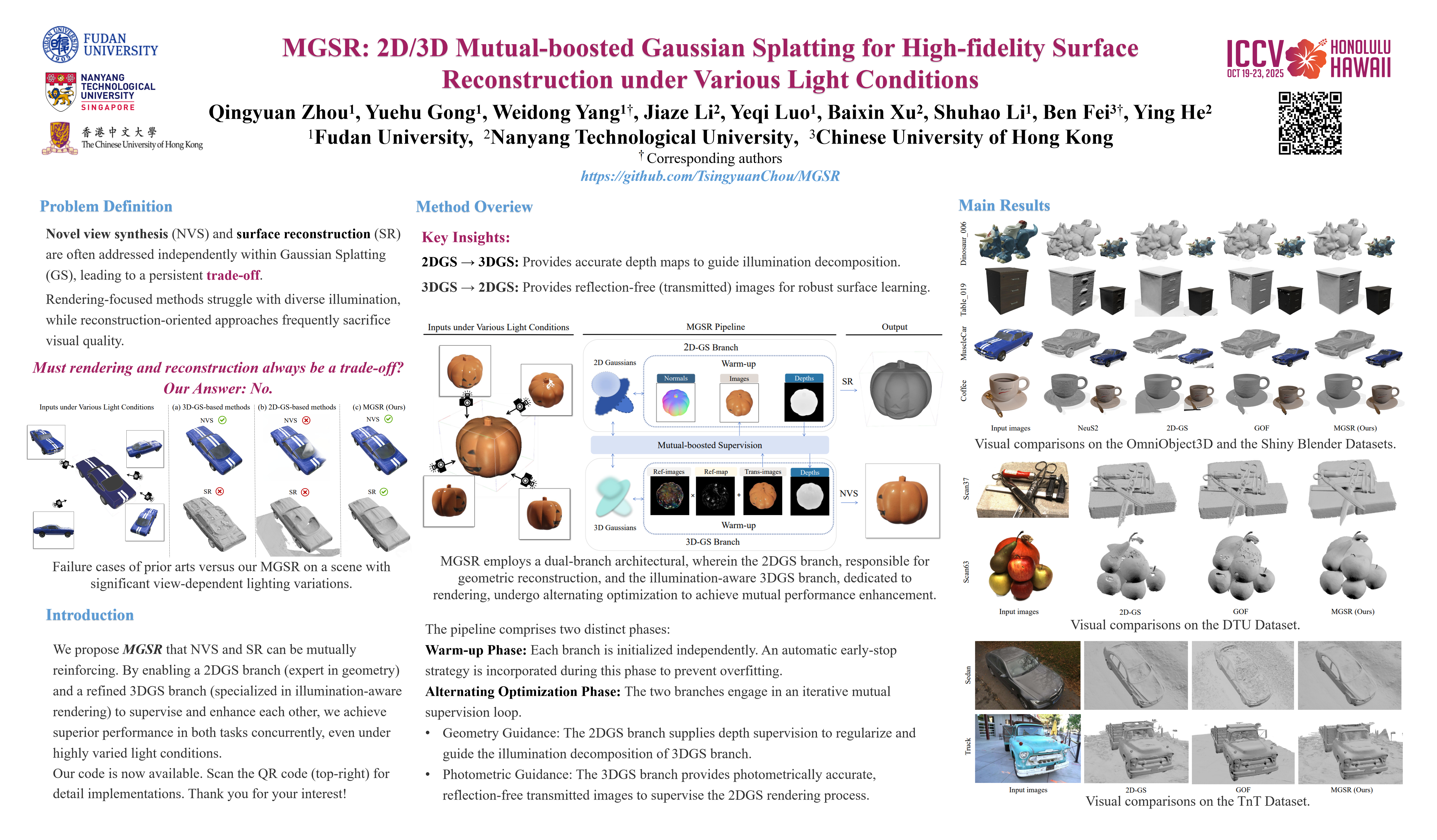
Novel view synthesis (NVS) and surface reconstruction (SR) are essential tasks in 3D Gaussian Splatting (3D-GS). Despite recent progress, these tasks are often addressed independently, with GS-based rendering methods struggling under diverse light conditions and failing to produce accurate surfaces, while GS-based reconstruction methods frequently compromise rendering quality. This raises a central question: must rendering and reconstruction always involve a trade-off? To address this, we propose $MGSR$, a 2D/3D $M$utual-boosted $G$aussian Splatting for $S$urface $R$econstruction that enhances both rendering quality and 3D reconstruction accuracy. MGSR introduces two branches—one based on 2D-GS and the other on 3D-GS. The 2D-GS branch excels in surface reconstruction, providing precise geometry information to the 3D-GS branch. Leveraging this geometry, the 3D-GS branch employs a geometry-guided illumination decomposition module that captures reflected and transmitted components, enabling realistic rendering under varied light conditions. Using the transmitted component as supervision, the 2D-GS branch also achieves high-fidelity surface reconstruction. Throughout the optimization process, the 2D-GS and 3D-GS branches undergo alternating optimization, providing mutual supervision. Prior to this, each branch completes an independent warm-up phase, with an early stopping strategy implemented to reduce computational costs. We evaluate MGSR on a diverse set of synthetic and real-world datasets, at both object and scene levels, demonstrating strong performance in rendering and surface reconstruction.
Chat is not available.
Successful Page Load